


Explore a real-world Hague Convention child abduction case involving parents from Mexico and a child wrongfully taken to California, highlighting key issues in international family law and cross-border custody disputes.

Hague Convention: A Case Study of the Wrongful Removal of a Child from Mexico to California
International family law disputes often arise when one parent relocates a child across national borders without the consent of the other parent. These cases are governed by the Hague Convention on the Civil Aspects of International Child Abduction, a treaty designed to ensure the prompt return of children wrongfully removed from their country of habitual residence. This case study examines a real-world legal scenario involving parents from Mexico, a child wrongfully taken to California, and the legal process that resulted in the child’s return to Mexico.
Background of the Case
The mother, father, and minor child were living together in Mexico and were Mexican citizens. In 2024, the parents separated. Approximately one month after the separation, the father scheduled an appointment with a family law attorney in Mexico to draft a custody and visitation agreement. Both parents were expected to attend the meeting to formalize arrangements regarding the care of their minor child. On the day the meeting was scheduled, the mother did not appear. Instead, she traveled with the minor child and her own mother to the United States. They successfully crossed the border and relocated to Alameda County, California, where they moved in with extended family. When the father returned home and could not locate the mother or child, he immediately contacted his attorney. Law enforcement authorities were notified, and an Amber Alert was issued in Mexico. Several days later, a cousin of the mother contacted the father and informed him that the mother and child were now in California.
Filing a Hague Convention Application
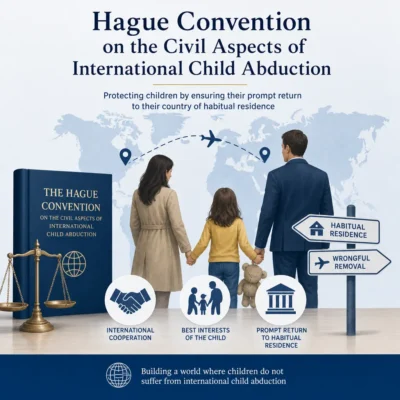
Upon learning the child had been taken to the United States, the father returned to his attorney and initiated legal action under the Hague Convention on the Civil Aspects of International Child Abduction. Purpose of the Hague Convention The Hague Convention is an international treaty designed to:
- Protect children from international parental abduction
- Ensure the prompt return of children to their country of habitual residence
- Prevent parents from seeking a favorable custody ruling in another country
Importantly, Hague Convention cases do not determine custody. Instead, they determine which country has the authority to decide custody matters.
The Hague Application Process The Hague Convention establishes a specific legal procedure for recovering a child wrongfully removed across international borders.
- Step 1: Filing the Hague Petition
The father filed a Hague Convention return application through the appropriate authorities in Mexico. The petition asserted that the child had been wrongfully removed from Mexico without the father’s consent.
- Step 2: Transmission to U.S. Authorities
Mexico transmitted the application through international treaty channels. The Mexican consulate delivered the Hague application to the District Attorney in Alameda County, California.
- Step 3: Court Filing in California
After receiving the petition, the Alameda County District Attorney initiated proceedings in Family Court to determine whether the child had been wrongfully removed under the Hague Convention.
Role of the District Attorney In Hague Convention cases in California, the District Attorney does not represent either parent. Instead, the office acts as a neutral government authority responsible for enforcing the treaty once the court determines whether the child must be returned. Legal Representation and Litigation Strategy The father retained Woodman Garcia-Sepulveda Law in California to represent him in the Hague Convention proceedings.

To prevail under the Hague Convention, the father needed to prove three primary legal elements: Element 1: Existence of a Parent-Child Relationship Evidence had to show that the petitioner was the child’s legal father with recognized parental rights. Element 2: Country of Habitual Residence
To succeed under the Hague Convention, the petitioner was required to prove that the child’s habitual residence was Mexico immediately before the wrongful removal. In international child abduction cases, habitual residence refers to the country where the child has been primarily living and where their day-to-day life is centered.
In this case, the court considered several forms of evidence demonstrating the child’s strong ties to Mexico. Birth records helped establish the child’s connection to the country from birth, while residency documentation showed that the family had been living in Mexico on an ongoing basis. The petitioner also presented evidence related to the child’s schooling, daily routines, and living arrangements, all of which supported the conclusion that the child’s primary home environment was in Mexico rather than the United States.
Taken together, this evidence demonstrated that Mexico was the child’s habitual residence under the Hague Convention.
Element 3: Wrongful Removal
Under the Hague Convention, the father was required to demonstrate that the child was wrongfully removed from Mexico in violation of his custodial rights. This meant showing that the mother relocated the child to another country without his knowledge, permission, or legal authorization.
To establish wrongful removal, the father presented evidence that he had not consented to the child’s relocation from Mexico to the United States. He also showed that there was no court order or legal agreement granting the mother the right to permanently move the child outside the country. Because the father was actively exercising his parental and custodial rights at the time of the removal, the unauthorized relocation interfered with those rights under Mexican law.
Taken together, these facts satisfied the Hague Convention’s definition of wrongful removal, which is intended to prevent one parent from unilaterally changing a child’s country of residence without proper legal authority or the consent of the other parent.
Mother’s Legal Defenses Although the Hague Convention generally favors the prompt return of children to their country of habitual residence, it also recognizes several limited exceptions designed to protect children from serious danger or injustice. In this case, the mother raised two primary defenses in an effort to prevent the child’s return to Mexico. Defense 1: Domestic Violence The mother argued that she left Mexico in order to escape domestic violence. She claimed that returning the child would place both herself and the child back into an unsafe environment. Under the Hague Convention, courts may decline to order a child’s return when there is credible evidence showing that a parent fled serious abuse or threats of violence. In evaluating this type of defense, courts closely examine the nature and severity of the alleged abuse, as well as whether the evidence demonstrates an actual risk to the child. Judges may consider police reports, medical records, witness testimony, protective orders, communications between the parties, and other supporting documentation. The court must determine whether the allegations are sufficiently supported and whether protective measures could address any safety concerns if the child is returned. Defense 2: Grave Risk of Harm The mother also asserted the “grave risk” exception, arguing that returning the child to Mexico would expose the child to serious physical or psychological harm. This is one of the most significant defenses available under the Hague Convention, but it is also interpreted narrowly by courts to prevent misuse in ordinary custody disputes. To succeed on a grave risk defense, the responding parent must present substantial and persuasive evidence showing that the child would face a serious and immediate danger if returned. General concerns about instability, financial hardship, or disagreements between parents are typically not enough. Instead, courts look for evidence of severe abuse, neglect, threats, or circumstances that would place the child in an intolerable situation. Because Hague Convention proceedings focus primarily on jurisdiction rather than long-term custody decisions, these defenses carry a high evidentiary burden. The court must carefully balance the Convention’s goal of discouraging international child abduction with the need to protect children from genuine harm. Court Findings During the hearing in the Alameda County Family Court, the court evaluated testimony and documentary evidence presented by both sides. The court found that:
- A valid father-child relationship existed.
- The child was born and had lived in Mexico.
- The mother removed the child from Mexico without the father’s permission and without a court order.
These findings satisfied the legal requirements for wrongful removal under the Hague Convention. The court also determined that:
- The mother did not provide sufficient evidence of domestic violence.
- The evidence did not establish that the child would suffer grave or irreparable harm if returned to Mexico.
Court Order Based on these findings, the court ordered that the child be returned to Mexico forthwith. This ruling restored jurisdiction over custody issues to the Mexican courts.

Limitations of Hague Convention Cases
Hague Convention proceedings are intentionally narrow in scope and are not designed to resolve broader family law disputes between parents. Instead, the Convention focuses on one specific issue: whether a child was wrongfully removed from or retained outside their country of habitual residence.
As a result, courts hearing Hague Convention petitions do not decide permanent custody matters or determine which parent should ultimately have primary custody of the child. They also do not create long-term parenting plans, establish child support obligations, or decide future visitation schedules. Those issues are typically left to the courts in the child’s country of habitual residence, where a full custody proceeding can take place.
The central question in a Hague Convention case is whether the child was wrongfully removed in violation of the other parent’s custodial rights. If the court determines that the removal was wrongful and no valid defense applies, the court generally orders the child returned to the appropriate country so that custody issues can be resolved there.
This limited framework serves an important international purpose. It discourages parents from attempting to gain an advantage in custody disputes by unilaterally relocating a child to another country and seeking a more favorable legal outcome elsewhere. By requiring custody disputes to be addressed in the child’s habitual residence, the Hague Convention promotes stability, consistency, and international cooperation between courts.
Key Takeaways for International Child Custody Disputes
This case highlights several important principles that frequently arise in international family law disputes involving the Hague Convention. First, the Convention provides a legal mechanism designed to address international child abduction quickly and efficiently. Its primary goal is to restore the child to their country of habitual residence so that custody matters can be decided by the appropriate court rather than allowing one parent to gain an advantage through unilateral relocation.
The case also demonstrates that Hague Convention proceedings are not custody trials. Courts hearing these petitions do not determine which parent is the better caregiver or what long-term custody arrangement would be in the child’s best interests. Instead, the court’s role is limited to deciding whether the child was wrongfully removed or retained under the standards established by the Convention.
In addition, the case illustrates that defenses such as domestic violence allegations or claims of grave risk of harm are taken seriously but require substantial and credible evidence. Courts carefully evaluate these defenses because they can override the Convention’s general requirement that the child be returned. However, unsupported allegations or generalized concerns are typically insufficient to prevent return under the treaty.
Finally, the case reinforces the principle that custody decisions should generally be made in the child’s country of habitual residence. By returning jurisdiction to the appropriate country, the Hague Convention helps maintain consistency in international custody disputes and discourages parents from attempting to secure a more favorable outcome by relocating a child across borders.
Conclusion International parental child abduction cases are complex and emotionally charged, but the Hague Convention on the Civil Aspects of International Child Abduction provides a structured legal framework to resolve them. In this case, Woodman Garcia-Sepulveda Law successfully demonstrated that the child was wrongfully removed from Mexico. Because the mother’s defenses were unsupported by sufficient evidence, the California court ordered the child returned to Mexico, where the appropriate courts could address custody and visitation matters. For families involved in cross-border custody disputes, understanding the Hague Convention process is critical to protecting parental rights and ensuring that jurisdiction remains with the proper court system.
Subscribe to our Newsletter

Flora Garcia-Sepulveda
Latest Posts
 by Flora Garcia-Sepulveda
Virtual Divorce Mediation in California: 8 Essential Things to Know in 2026
A practical, 2026 guide to completing divorce mediation entirely online in California — what's legally binding, what's secure, and where AI tools actually...
by Flora Garcia-Sepulveda8 Smart Financial Planning Strategies Before Filing for Legal Separation
If you are considering legal separation, the financial side of the decision can feel just as overwhelming as the emotional side. Questions about bank...
by Flora Garcia-SepulvedaHow Are 401Ks, Pensions, and Retirement Accounts Divided in a California Divorce?
What's the best way to manage 401K, pension divisions during divorce? For many Bay Area couples, a 401K, pension, or other employer retirement plan is the...